
Federal Release Status and Destination
A person may leave a BOP prison after sentence completion, transfer to community confinement, court action, or another federal event. The public locator can show that BOP custody ended, but it may not explain every later obligation or destination. Supervised release is a court-ordered period of oversight after incarceration. It is different from physical prison custody and can continue after the locator says “Released.”
BOP also warns that someone outside its custody may be on parole, under supervised release, held by another criminal-justice system, or otherwise controlled by another authority. The precise conclusion is therefore “no longer in BOP custody as of the listed release date.” Do not expand that into a claim that the person has no supervision, pending case, or other custody.
Confirm a Federal Inmate Release
Start with the custody system, then match at least two records when the conclusion matters. A name alone is not enough.
- Check the Montgomery County jail record if the person was locally housed and determine whether the exit was marked as release or federal transfer.
- Search the BOP locator by register number or another supported federal identifier. If no number is known, use the full name and narrowing fields.
- Compare the locator’s date and status with the federal criminal docket, judgment, or release order.
- For federal pretrial custody, use the court docket first and seek a specific USMS record only when the public case file is insufficient.
- If immigration custody is suspected, use the separate ICE locator and its contact route.
The Montgomery County released inmate search explains the local and state branches. Kentucky KOOL and VINE should not be substituted for a federal BOP result.
BOP Inmate Locator Coverage
The Federal Bureau of Prisons Inmate Locator is the main public source for federal prison records from 1982 to the present. Search by BOP register number or another supported federal identification number when possible. A name search can be narrowed with age, race, and sex.
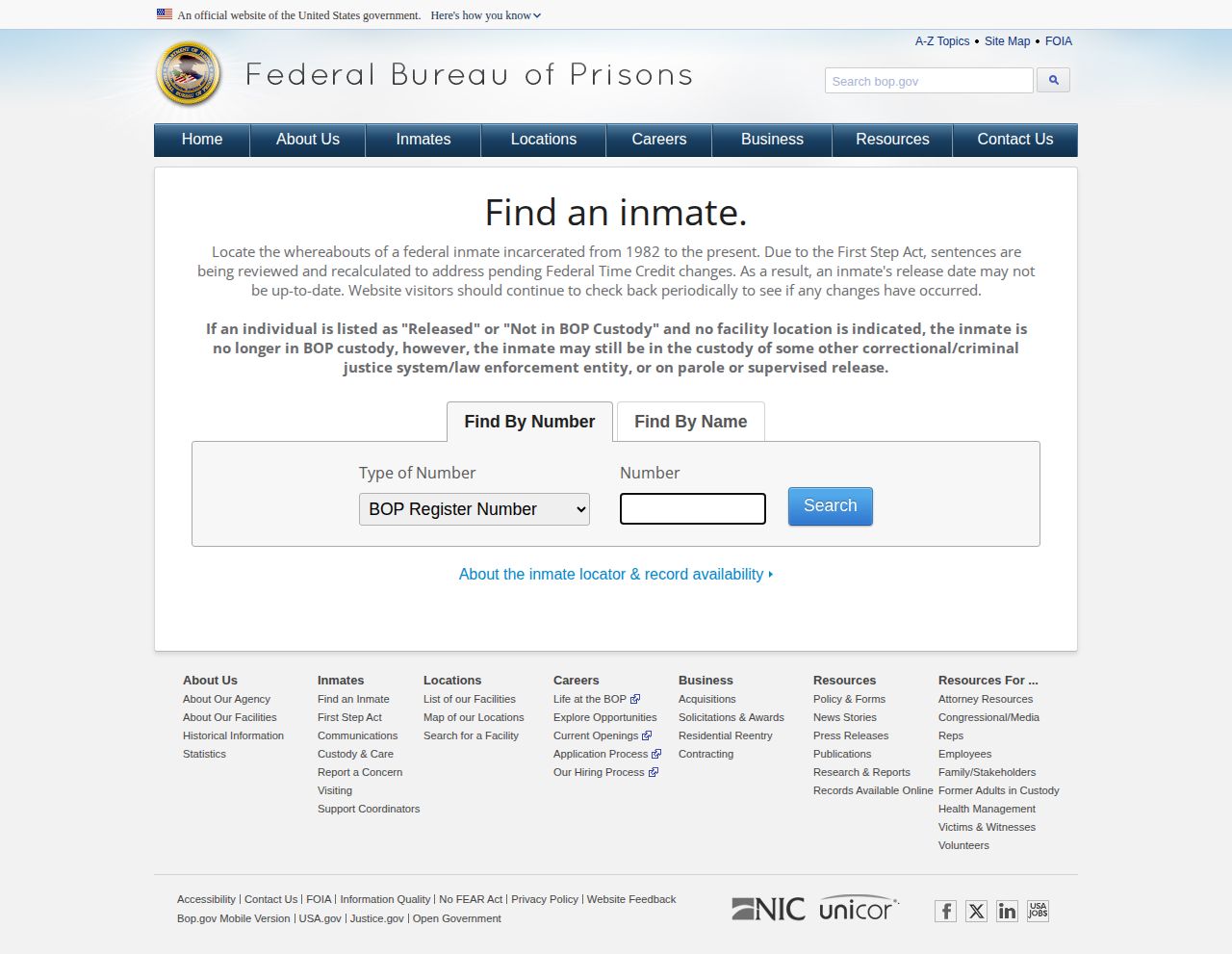
The official screen shows why exact identifiers matter and documents the locator’s federal scope. It is neither a county roster nor a combined nationwide record of every person held before trial.
Federal Locator Fields Explained
The BOP results table provides a compact identity and custody summary. Read all fields together before selecting a match.
| Field | How to interpret it |
|---|---|
| Name | Compare spelling, middle name, and suffix |
| Register number | The strongest public identifier for the BOP record |
| Age, race, and sex | Narrowing fields that help separate similar names |
| Release date | A BOP date that may be past, future, or later recalculated |
| Location | A current facility or a status such as “RELEASED” |
If the release date is in the past and no facility location appears, BOP explains that release occurred on that date and the person is no longer in BOP custody. “RELEASED” or “Not in BOP Custody” carries the same limited system meaning. A future date is not proof that physical release has already occurred.
Federal Records and Contact Routes
The BOP locator and its About Federal Inmate Records page are the first public contacts for sentenced federal custody. A federal court clerk provides the public docket and filed order. The U.S. Marshals Service FOIA office handles identifiable existing USMS custody records, subject to privacy and law-enforcement limits.
Federal system routing
BOP sentenced custody: BOP Inmate Locator and BOP records guidance
Federal release authority: the federal district court docket and order
Pretrial custody or transport: U.S. Marshals Service and its FOIA process
Older federal imprisonment: National Archives
Civil immigration detention: ICE Online Detainee Locator System
No single federal telephone desk can replace this source matching. Identify the stage of custody before making a request.
Federal Records Before 1982
Public BOP locator coverage is incomplete before 1982. For an older released federal inmate, BOP directs researchers to the National Archives. Supply the person’s full name, date of birth or approximate age during imprisonment, race, and approximate prison dates. Those details help archivists distinguish people with similar names and locate the correct record group.
The archive route applies to historical federal imprisonment. It is not a fallback for an old Montgomery County jail booking or a Kentucky state conviction. County records remain with local custodians, while state correctional records belong to Kentucky DOC.
USMS Pretrial Custody Records
The U.S. Marshals Service is responsible for federal prisoners from court-ordered custody through acquittal or conviction and delivery to BOP to serve a sentence. Many pre-sentence federal prisoners are housed in state, local, or private facilities. A person physically present in a county jail can therefore remain under federal authority.
Movement from a local jail may mean transport to court, transfer to another contract facility, acquittal, court-ordered release, or delivery to BOP. There is no general public USMS released-prisoner locator equal to the BOP search. A missing BOP record does not prove that USMS never held the person.
Confirm pretrial release through the federal docket and order. If a specific custody record is still needed, the USMS FOIA process accepts electronic or hard-copy requests. Identify the record, person, date range, and desired format. FOIA requires production of qualifying existing records, not research, analysis, answers to questions, or creation of a new record.
ICE Release Checks Are Separate
The ICE Online Detainee Locator System concerns civil immigration detention. It is separate from BOP, USMS, Kentucky DOC, and Montgomery County Regional Jail. Search with a nine-digit A-number and country of birth. Add leading zeroes when an A-number has fewer than nine digits. The alternative search requires an exact first and last name plus country of birth, with date of birth available for matching. People under 18 cannot be searched through ODLS.
ICE states that ODLS includes people currently detained by ICE or released from ICE custody within the last 60 days. It is a narrow recent-release trace, not a permanent history. A missing result can reflect the time limit, spelling, hyphenation, country-of-birth choice, a transfer, or another scope issue.
ICE information line
Detention Reporting and Information Line: 1-888-351-4024
Monday through Friday, excluding holidays
8 a.m. to 8 p.m. Eastern
A person released from ICE detention may still have field-office check-in duties and a pending immigration matter.
Federal Detainers and Montgomery Exits
A detainer asks a holding agency to keep or transfer a person for another authority. If Montgomery County Regional Jail relinquishes someone to USMS or ICE, county custody ended but community release may not have occurred. The local release sheet should preserve the destination or receiving agency when that field is public.
Likewise, leaving BOP custody does not rule out state, local, or immigration custody. Compare the county disposition, federal docket, BOP status, USMS stage, and ICE result rather than merging them into one generic release label. Check times should be recorded when systems disagree.
Request a Federal Release Record
Ask the agency that created the needed record. For BOP custody, identify the person by register number, full name, date of birth, and approximate dates. For USMS, request a named existing custody, transfer, or release record through FOIA. For the legal authority, request the public docket, detention order, judgment, or release order from the federal court.
Privacy and law-enforcement exemptions may restrict disclosure. A focused request is more useful than asking an agency to explain why events occurred. State the preferred electronic format and a clear date range. Preserve exact terms such as “Released,” “Not in BOP Custody,” “transfer,” or “supervised release” because each describes a different status.
About the Federal BOP System
The Federal Bureau of Prisons is the nationwide federal prison agency. It holds people serving federal sentences and manages related correctional placements. It does not operate Montgomery County Regional Jail. No adult BOP prison, ICE detention center, or other federal detention institution was identified inside Montgomery County during the official-source review.
A person charged in federal court can pass through USMS custody before entering BOP, and some people never enter BOP at all. That is why the case stage matters. BOP records answer sentenced federal prison questions. USMS and the federal docket answer pretrial detention and court-release questions. ICE answers a separate civil immigration question.
Public Record Search
Sponsored Results